Managing ESs & Inventory
August 26, 2025
Behind every event at the MIT Science Olympiad Invitational is a year-long effort of careful planning and coordination. To prepare for each of the 23 main and 3 trial events, we recruit and manage approximately 50 ESs and maintain a meticulously cataloged inventory of supplies—all so that over 70 competing teams can focus solely on giving their strongest performance and having a memorable experience on tournament day.
ES Management
After selecting the season’s ESs, we collaborate with them closely to ensure each of the tournament’s events run smoothly from initial exam drafts to ES travel logistics. You’ll see the behind-the-scenes of how we hold our event review process to maintain consistent quality and fairness across 72 competing teams as well as how we coordinate with Finance to bring our ESs to campus for tournament day.
Point Person System
To follow up on specific events and adhere to this general schedule, point people from the Events committee are assigned (volun-told?) to different events for oversight. For example, one of our members was the point person this year for Dynamic Planet, Geologic Mapping, Helicopter, and Materials Science.
As such, they communicated with the corresponding ESs, being the PC member of first point of contact, provided in-depth test review, and figured out any kinks along the way with the ESs. This consolidation helps to make sure there is no gap in knowledge, since there is a core lead for each event.
Members of the Events committee are essentially managers that ensure the ESs complete their assigned tasks in a timely manner and act as a liaison between the ESs and the rest of PC and MIT admin. We communicate with ESs primarily through Discord (the same one we later send out to all competitors).
Event Review Process
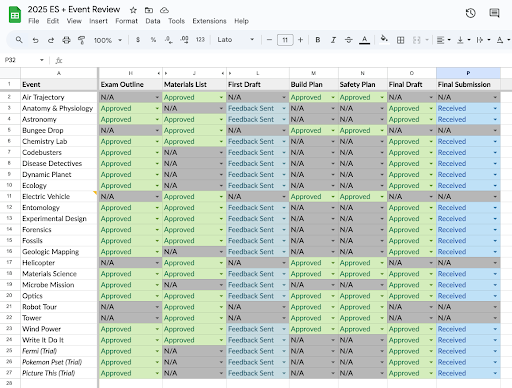
Figure 1. A screenshot of our spreadsheet for tracking the event review process for the 2025 MIT Invitational.
Our event review process is tracked by this spreadsheet where Planning Committee (PC) members look closely at drafts submitted by ESs before finalizing for printing. One of the most satisfying parts of being in the Events committee is seeing this spreadsheet evolve from being mostly empty to filled with approved exams, materials lists, and build plans. Few things can compare to the feeling of approving the final submission needed to run the complete tournament.
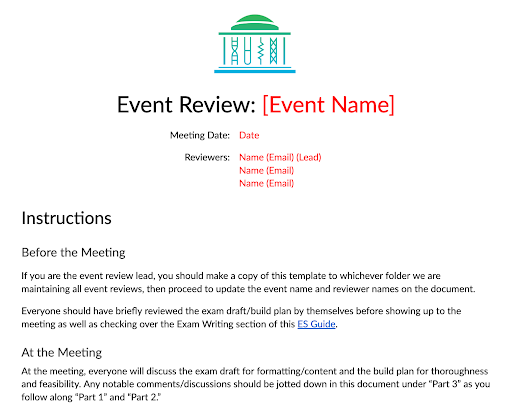
Figure 2. A preview of our 2025 event review template.
When reviewing event drafts, the event’s point person coordinates with other PC event reviewers to organize a meeting where they compile all their feedback into one document for the ESs to review.
During the exam review process, we apply much of the same criteria emphasized in our earlier blog post about sample questions in ES selection. We look heavily at the diversity and difficulty of questions to ensure they can differentiate the placements of ~72 teams as well as the ease of grading the exam.
It’s essential to ensure a good balance of question types and topics within the scope of the Nationals rules. An exam with mostly FRQs can take a long time to grade even with an endless supply of volunteer graders, while an exam with mostly MC can be considered too easy and prone to random guessing. Additionally, answer keys should be specific with clear point distributions to ensure fairness and consistency in the grading process.
Aside from exam composition, we look closely at question quality to make sure competitors have fun and learn something new as they take the test! As mentioned in the post about ES selection, we encourage ESs to make their questions more interesting and creative after each draft they submit.
We are also quite strict with formatting to make the test-taking experience as issue-free as possible for competitors. We ask for page numbers/team numbers on every page, slim but printable margins, clear instructions, and a front page that is distinct from the answer key. Unfortunately, there have been past instances where the ES almost gave competitors the answer key instead of the answer booklet. We aim to prevent these mistakes during the event review process.
ES Travel
Another large part of working with ESs from all over the nation is ES travel. Part of the reason our tournament is so highly regarded is because we get the best ESs from all over the country. We are very proud to foot the bill for these hardworking (and volunteer!) ESs.
We provide both housing and reimbursements for travel costs (bus, train, or plane). We coordinate housing by pairing ESs with either a PC member or MIT student volunteer where ESs stay at their dorm with a complementary air mattress.
Travel reimbursements require collaboration between the Events and Finance committees. Overall, the process involves having the ES submit a proposed travel plan that the Finance committee approves or asks the ES to revise. The ES will then pay for their own travel, and Finance will reimburse their submitted receipts.
Inventory & Materials
Running a tournament, especially one as large as ours, requires lots of supplies! For instance, build events need (often custom-engineered) setups, lab events need chemicals and glassware/containers, and inquiry events like WIDI need lots of craft supplies. We also go above and beyond by providing test events with models, specimens, and anything else they might need. With all this in mind, managing our inventory and getting everything ready for tournament day takes lots of coordination.
Inventory Check
We store our supplies in a room in Walker Memorial, which happens to be where we take a lot of our midterm exams. A couple times each year, the Events committee meets to do an inventory check, where we sift through everything in this room and keep accurate records in a spreadsheet.
Each year, we discover lots of interesting things in our inventory from past years like a 2023 binder with a team’s Trajectory design*, preserved organs, and taxidermied bats! This process typically takes an entire evening, so we usually take a break in the middle to eat dinner or drink boba.
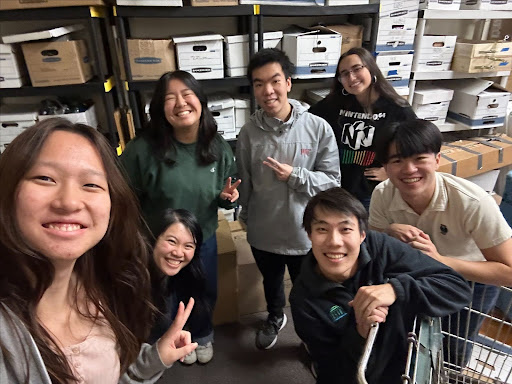
Figure 3. TDs + Members of Events Committee after completing Fall 2024 Inventory. From left to right, Amber Luo, Elisa Xia, Wendy Geng, Richard Deng, Derek Chen, Eleni Morales, and Tyler Matsuzaki.
This year, we implemented a new system inspired by the Dewey Decimal system for organizing the numerous boxes in our inventory. Each box gets a number, where the first digit represents a category. For example, 300s are build supplies, 400s are inquiry, 800s are office supplies, etc.
This new system made it much more efficient to sort through inventory and get supplies on tournament day, and played a big overall role in making our tournament run more smoothly.
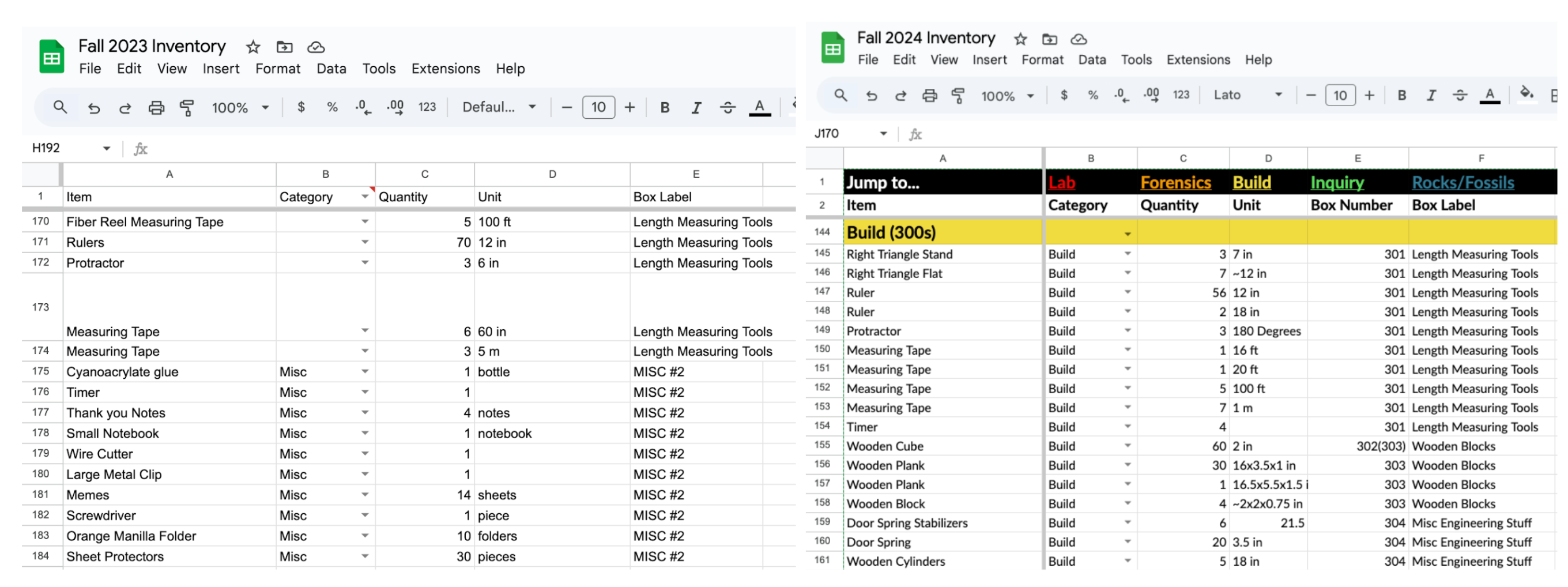
Figure 4. A screenshot of our Fall 2023 inventory spreadsheet and the updated format for our Fall 2024 inventory.
*If this sounds like your team’s binder, feel free to email scioly@mit.edu, and we can mail it to you!
Acquiring Materials
Once inventory check is done, we communicate with ESs to make sure they have what they need to run their events. We first ask them to submit materials requests based on our inventory. If ESs need anything we do not have in inventory, that’s our cue to work with Finance to buy what they need.
Usually, this just involves placing an Amazon order to one of our dorms, but there are two main exceptions to this procedure:
- MIT doesn’t allow us to ship chemicals to dorms, but if we have a UROP in a department like chemistry or biology, then we can get chemicals shipped to our lab.
- Other items like bags of sand or wooden planks are simply too bulky or expensive to ship easily, so in this case, we make a trip to Home Depot to carry everything.
Leading up to the tournament, we work closely with ESs to prepare for their events. If the ES is local, then it’s easy for them to just come to inventory to look at their supplies, but otherwise someone on Events is available on demand to go to inventory and send photos of anything that would be useful for them to see (i.e. our Tower set-up and Fossils collection).
Reflection
To ensure our tournament runs smoothly, having an organized workflow as well as keeping track of all updates and potential failure modes are key. We are meticulous about communicating to ESs about all they need to know through on-boarding with an ES orientation and guide as well as the point person communication system through Discord.
Keeping an organized inventory is also essential for ensuring that each event receives all the materials needed for tournament day and that we can deliver a high-quality, issue-free experience for all competitors.
MIT Science Olympiad has a high turnover rate year to year as we are primarily run by undergraduate students who stay at most 4 years at a time. However, this general workflow of managing ESs and inventory has stayed fairly consistent with minor efficiency changes over time. With detailed documentation and a system to ensure the passage of knowledge from older to younger PC, we are able to ensure the MIT Science Olympiad can retain its level of quality from year to year.